

A 2022 Harvard Business Review study revealed a striking gap: 70% of respondents couldn’t define the term reshaping digital interactions. This technology, conceptualized by computer scientist Gavin Wood, moves beyond today’s centralized platforms. Instead, it empowers users through shared control of data and systems.
Since 2018, interest has surged across industries. Venture capitalists poured $30B+ into related projects last year alone. Patent filings grew by 140%, while job postings mentioning blockchain skills tripled globally. Even traditional sectors like banking now explore its potential.
For individuals, this shift means more than technical jargon. Imagine owning your social media content outright or monetizing gaming achievements securely. Communities—not corporations—could govern online spaces, creating fairer revenue models. Artists in India already use these systems to bypass intermediaries and sell directly to fans.
As adoption accelerates, early understanding becomes vital. Whether you’re a professional adapting to new tools or a creator exploring digital ownership, grasping these changes unlocks opportunities. Let’s explore what drives this movement and how it might reshape your online experiences.
Key Takeaways
- Over two-thirds of people remain unfamiliar with this emerging digital framework
- Decentralized systems shift power from corporations to user communities
- Investment in related infrastructure grew exponentially since 2018
- New economic models enable direct creator-to-consumer transactions
- Early adopters gain advantages in evolving job markets
Introduction to the New Era of the Internet
Every day, 4.9 billion people access digital services that shape careers, education, and social connections. The current web infrastructure operates like a walled garden—tech giants manage user data, content policies, and profit flows. This centralized model faces growing criticism as IP traffic tripled since 2017, exposing vulnerabilities in privacy and fair access.
Emerging community-driven networks propose a radical shift. Instead of corporate servers, shared ledgers enable users to collectively verify transactions and govern platforms. Imagine farmers in Punjab trading crops directly with buyers using tamper-proof records, bypassing costly middlemen. Such systems prioritize transparency over hidden algorithms.
| Feature | Current Web | Next-Gen Web |
|---|---|---|
| Control | Centralized corporations | User communities |
| Data Ownership | Platforms retain rights | Individuals hold keys |
| Governance | Top-down policies | Voting mechanisms |
India’s digital adoption surge makes this transition timely. Over 700 million internet users now face data monetization debates and censorship risks. New frameworks let creators sell art or music without losing 30% commissions to app stores. The future web could redistribute $15 trillion in annual online revenue more equitably.
Web3 Explained, What is Web3, Web3 for Beginners, Web3 Trends 2025
Imagine an internet where your photos, messages, and purchases aren’t stored in corporate servers. This vision drives decentralized systems built on blockchain frameworks. At its core, blockchain acts as a shared ledger maintained by thousands of computers worldwide. Each transaction gets verified collectively, making tampering nearly impossible.
Traditional platforms like social media sites hold your data hostage—you can’t move or monetize it freely. New networks flip this model. Farmers in Punjab now test crop-trading systems where harvest records live on shared ledgers. Buyers verify quality without middlemen taking 40% cuts.
| Aspect | Current Systems | Blockchain-Based Systems |
|---|---|---|
| Access | Permission-based | Open participation |
| Security | Centralized servers | Distributed verification |
| Ownership | Platform retains rights | User holds digital keys |
Creators benefit most. Musicians in Mumbai upload tracks directly to fan communities using smart contracts. Payments auto-process without labels taking cuts. “My earnings doubled when I bypassed streaming platforms,” shares indie artist Riya Kapoor.
Emerging developments blend AI with decentralized networks. Future tools might auto-negotiate contracts or protect digital art using unique identifiers. These shifts redefine how we work and connect online—putting people back in charge of their digital lives.
Evolution of the Internet: From Web1 and Web2 to Web3
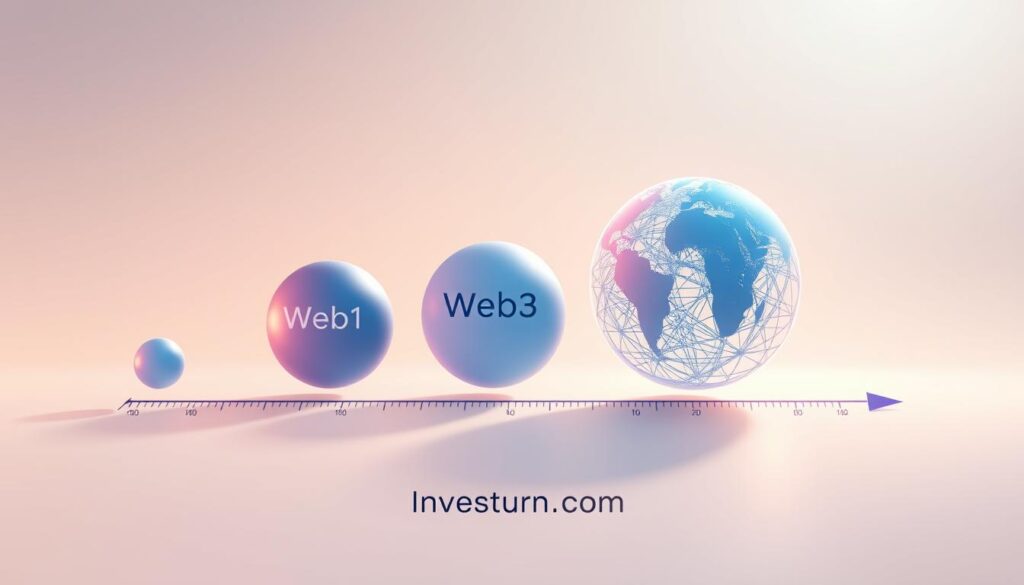
The digital world has transformed dramatically since its early days. To grasp today’s decentralized movement, we must first revisit how online experiences evolved through three distinct phases.
Understanding Web1 and Web2
The 1990s introduced Web1—a static landscape of basic HTML pages. Users could read articles or chat on forums, but creating content required coding skills. Open protocols like HTTP allowed universal access, yet interaction resembled a digital library more than a collaborative space.
Web 2.0 changed everything in the mid-2000s. Platforms like Facebook and Wikipedia turned spectators into creators. Suddenly, anyone could share photos, edit entries, or build communities. But this convenience came at a cost—companies monetized user data through targeted ads while controlling platform rules.
| Aspect | Web1 | Web 2.0 |
|---|---|---|
| Interaction | Read-only | Read-Write |
| Control | Decentralized | Corporate-owned |
| Revenue Model | Limited | Data-driven ads |
Transitioning to a Decentralized Web3
Modern users demand both participation and ownership—a gap today’s systems struggle to fill. Farmers in Rajasthan now bypass middlemen using shared ledgers, while artists sell directly to fans. These examples hint at a hybrid future: combining Web1’s openness with Web 2.0’s interactivity, but placing control in users’ hands.
“We’re rebuilding the web’s foundation,” explains Bengaluru-based developer Arjun Mehta. His team creates tools letting communities govern platforms through voting systems. This shift could redefine how we work, create, and trust online interactions.
Key Technologies Powering Web3

Digital trust systems now rely on three breakthrough innovations reshaping how we exchange value. These technologies eliminate middlemen while ensuring secure, transparent interactions.
Blockchain Technology and Digital Ledgers
Blockchain acts as a shared notebook maintained by thousands of computers globally. Each transaction gets recorded across this network, making unauthorized changes nearly impossible. Farmers in Gujarat now track crop shipments using these systems, reducing disputes with buyers by 80%.
Smart Contracts and Automated Agreements
These digital scripts execute actions when conditions meet. For example, insurance claims auto-process when flight delays exceed 3 hours. Bengaluru startup NexContract saved 12,000 work hours annually by automating supply chain payments through this technology.
| Feature | Traditional Contracts | Smart Contracts |
|---|---|---|
| Speed | Days/weeks | Minutes |
| Cost | Legal fees | Network fees |
| Transparency | Limited | Full visibility |
Digital Assets: Cryptocurrencies and NFTs
From Mumbai artists selling music tokens to hospitals securing patient records, digital assets create new economic models. NFT sales surged 68% last year despite market dips. Stablecoins now handle over $7B daily in cross-border payments, cutting remittance costs for Indian workers abroad.
These technologies form an interconnected ecosystem. Blockchain provides the foundation, smart contracts enable automation, and digital assets fuel participation. Together, they’re rewriting the rules of digital ownership and collaboration.
How Web3 is Disrupting Traditional Internet Models
Today’s internet giants operate like digital landlords—they own the platforms, set the rules, and take hefty cuts from every transaction. This centralized model faces unprecedented challenges as blockchain networks redistribute authority across users. Picture a Mumbai street vendor selling handmade goods through a cooperative app where all members vote on fees and features.
From Corporate Gatekeepers to Community Rulebooks
Traditional platforms maintain absolute control over data flows. Social media companies can freeze accounts, app stores take 30% commissions, and payment processors block transactions. Blockchain systems break these chokeholds by spreading verification tasks across global networks.
Consider these fundamental shifts:
- Decisions get made through token-based voting instead of boardroom meetings
- Data lives in shared ledgers rather than corporate servers
- Smart contracts auto-enforce rules without human bias
A Bengaluru startup recently demonstrated this shift. Their artist platform lets musicians set royalty terms through code. When a song gets streamed, payments split automatically between creators and collaborators. “We removed three middlemen from every transaction,” explains co-founder Priya Sharma.
| Aspect | Centralized Model | Decentralized Model |
|---|---|---|
| Decision Making | Corporate executives | Token holders vote |
| Revenue Share | Platform keeps 20-30% | Network fees under 5% |
| Outage Risk | Single server failure | Distributed nodes |
This transition brings new responsibilities. Users must secure digital wallets and understand governance proposals. However, the trade-off—true ownership of digital assets and a say in platform evolution—is reshaping how we interact online.
Web3 and the Future of Decentralization in India
India’s tech revolution enters a new phase as decentralized systems reshape how businesses operate. With global investments in related startups surpassing $23.7 billion, Indian entrepreneurs now pioneer solutions tailored to local challenges.
Impact on Local Businesses and Startups
Small manufacturers in Tamil Nadu now track shipments using blockchain ledgers, reducing delivery disputes by 65%. Smart contracts help Mumbai exporters automate customs compliance, cutting paperwork time from weeks to hours. These innovations address critical gaps in India’s $3 trillion economy.
| Business Challenge | Traditional Approach | Web3 Solution |
|---|---|---|
| Cross-border payments | 5-7 days, 8% fees | Instant, under 1% cost |
| Supply chain tracking | Manual records | Tamper-proof digital trails |
| Regulatory compliance | Third-party audits | Auto-verified transactions |
Bengaluru-based FinTech startup DappX recently secured $4.2 million to develop regional language smart contracts. “Our tools help shop owners create digital warranties without coding skills,” explains CEO Anika Patel. Such developments could empower 63 million SMEs to join global markets.
The Reserve Bank of India’s digital rupee trials signal growing institutional interest. Combined with a 500% increase in blockchain developer registrations since 2021, these trends position India as a potential leader in decentralized systems.
Real-World Web3 Applications and Use Cases
Industries worldwide now test practical implementations of decentralized systems. These real-world examples demonstrate how shared networks solve persistent challenges in finance and entertainment.
Financial Services and Cross-Border Transactions
JPMorgan Chase’s 2022 blockchain transfer of Singaporean dollars and Japanese yen showcases streamlined global payments. Securitize’s Avalanche-based fund with KKR allows individual investors to access private equity—previously limited to institutions. Such systems reduce transaction times from days to minutes while cutting fees by 70%.
Gaming, Digital Art, and Virtual Experiences
Players now own in-game assets through blockchain records, creating resale markets for rare items. Mumbai-based artists use similar software to sell limited-edition digital art directly to collectors. One creator collective reported $2.8 million in NFT sales during their debut virtual gallery exhibition.
These use cases reveal a pattern: decentralized tools empower users while improving transparency. As more industries adopt these models, early adopters gain competitive advantages in evolving digital markets.
FAQ
How does blockchain enable decentralized systems?
Blockchain creates a shared digital ledger that records transactions across multiple devices. This eliminates reliance on central authorities like banks or tech giants, giving users direct control over data and assets.
What role do NFTs play in virtual economies?
Non-fungible tokens authenticate ownership of digital items like art, music, or in-game assets. Platforms like OpenSea and Decentraland use NFTs to enable peer-to-peer trading without intermediaries.
Can decentralized finance replace traditional banking?
DeFi platforms like Aave and Uniswap offer lending, borrowing, and trading using smart contracts. While not a full replacement, they provide alternatives with faster cross-border transactions and lower fees.
Why are companies like Meta investing in virtual worlds?
Immersive 3D environments (e.g., Meta’s Horizon Worlds) blend social interaction, commerce, and entertainment. These spaces leverage digital currencies and blockchain to create user-owned economies.
How does India’s tech ecosystem benefit from this shift?
Startups like Polygon and CoinSwitch are building infrastructure for tokenized assets and decentralized apps. This fosters innovation in supply chains, real estate, and microtransactions tailored to local needs.
Are smart contracts legally enforceable?
While code executes agreements automatically, legal recognition varies by region. Ethereum-based contracts are increasingly used for insurance payouts and royalty distribution, with courts beginning to acknowledge their validity.
What risks come with peer-to-peer data storage?
Networks like IPFS reduce server dependence but face challenges in data retrieval speeds and content moderation. Projects like Filecoin incentivize reliable storage through cryptocurrency rewards.
How do DAOs challenge corporate structures?
Decentralized Autonomous Organizations (e.g., MakerDAO) let token holders vote on decisions traditionally made by executives. This redistributes power but requires robust governance frameworks to prevent disputes.

